
Our research
We study the electronic structure of strongly correlated electron systems and functional materials such as high-temperature superconductors, topological insulators, and graphene materials with ultrahigh-resolution angle-resolved photoemission spectroscopy (ARPES). ARPES is a unique and powerful experimental technique to directly observe the momentum-resolved electronic structure. We have constructed an ultrahigh-resolution ARPES spectrometer in our laboratory and the present energy resolution (1.3 meV) is in the world-best level.On-going researches:
1) Electronic structure and mechanism of high-temperature superconductors
2) Electronic structure of topological insulators
3) Electronic structure of atomic-layer materials
4) Electronic structure of new functional thin films
Equipments:
(1) Ultrahigh-resolution ARPES spectrometer (1st version)
(2) Ultrahigh-resolution ARPES spectrometer (2nd version)
(3) Bulk-sensitive spin-resolved ultrahigh-resolution ARPES spectrometer (3rd version)
(4) Bulk-sensitive spin-resolved ultrahigh-resolution ARPES spectrometer (4th version)
(5) High-resolution ARPES spectrometer at NanoTerasu (under construction)
We also use synchrotron radiation facilities such as NanoTerasu, SPring-8, Photon Factory (PF), UVSOR, SOLEIL (France), and DIAMOND (United Kingdom).

Fig.1 Flowchart of our research
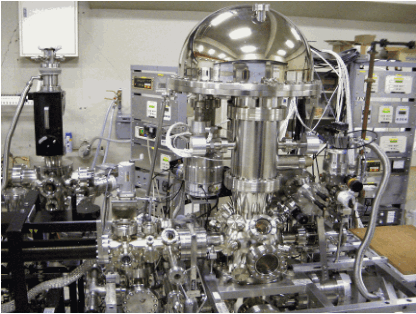
Fig.2 High resolution ARPES system

Fig.3 Energy bands of topological insulators by ARPES
High-Tc superconductors

Fig.4 Superconducting gap of Fe-based superconductor

Fig.5 Schematics of atomic-layer Fe-based superconductor
Topological insulators

Fig.6 Dirac cone band and spin current at the surface of 3D topological insulator
Atomic-layer materials

Fig.7 Schematic views of sandwich graphene and twisted bilayer graphene
New functional films

Fig.8 New platform for topological superconductivity realized by a heterojunction of atomic layer thin films (Pb) and topological insulators that do not require superconducting proximity effects
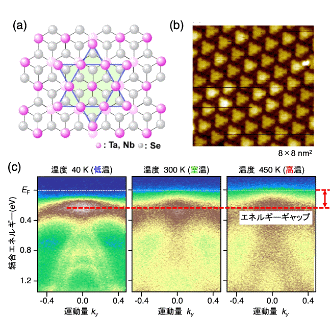
Fig.9 Fabrication of monolayer Mott-insulator 1T-TaSe2. Unique charge density waves and robust Mott-Haberd gap at room temperature are observed.
Development of start-of-the-art ARPES

Fig.10 Schematic view (left) and photograph (right) of the nano spin ARPES systems under construction
CREST project
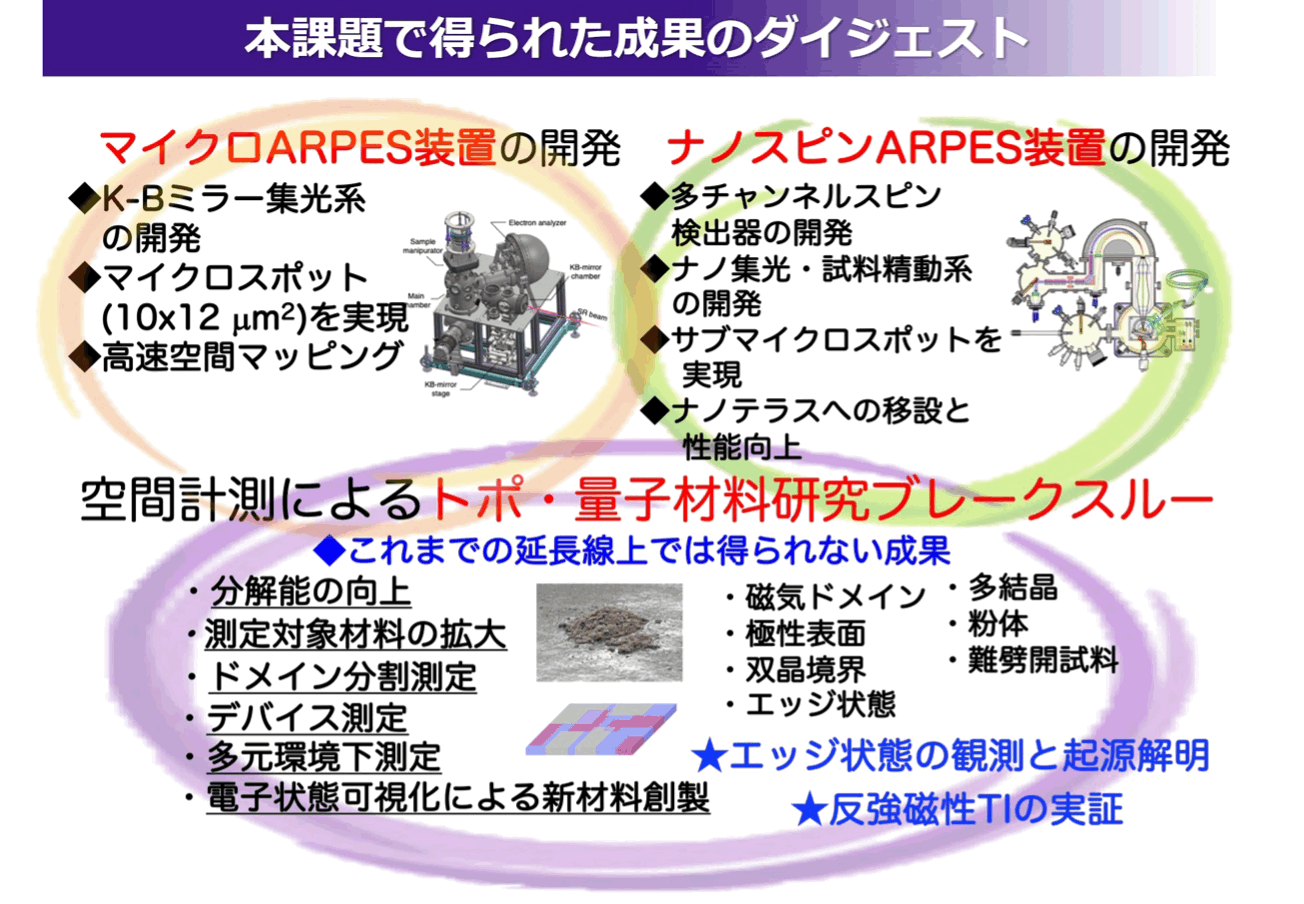
Fig.11 Summary of the results obtained from JST-CREST research project